
From Battlefield to Art: The Definitive History and Evolution of Japanese Rope

Updated: May 3
The practice of Japanese rope art—known today as Shibari or Kinbaku—is a journey of transformation. It began as a brutal martial necessity on the battlefields of feudal Japan and evolved into one of the most sophisticated forms of artistic and erotic expression in the world. For anyone practicing in the modern scene, understanding this lineage is about honoring the Kokoro (the heart or spirit) of the rope.
The Martial Origins: Hojojutsu (1400s – 1860s)
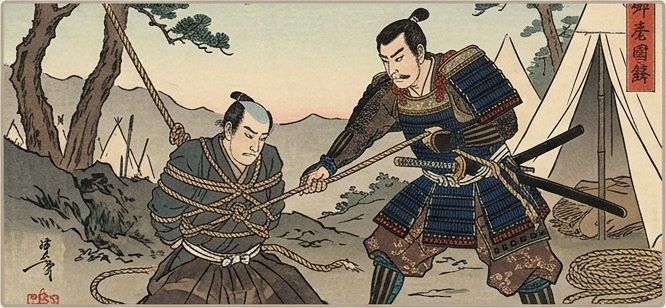
Before rope was an art, it was a weapon. Hojojutsu (the martial art of restraining with rope) was developed during the Muromachi and Sengoku periods. In a time when iron was expensive and heavy, a samurai carried a length of cord (Hojo) to capture and restrain enemies or criminals.
Unlike Western restraint, which focused solely on immobilization, Hojojutsu was a complete martial system. It was taught within specialized schools known as Koryū.
Regarding Social Status
A key historical fact of Hojojutsu was its adherence to the strict social hierarchy of the Edo period. The way a person was tied communicated their social standing to the public and the courts:
Samurai and Nobility: These prisoners were tied with "Dignity Ties." The rope was often hidden under their clothes or tied in a way that didn't humiliate their family name.
Commoners and Thieves: Ties were more restrictive, visible, and often intentionally painful.
Women: Specialized ties were used to avoid violating specific cultural taboos while ensuring they could not escape or commit suicide (a common concern for high-ranking captives).
The knots were designed to be "tamper-evident." Because the guards knew the specific geometry of their school (such as the Itatsu-ryu or Takenouchi-ryu), any attempt by the prisoner to loosen the rope would be immediately visible.
An Artistic Pivot: Kabuki and Ukiyo-e
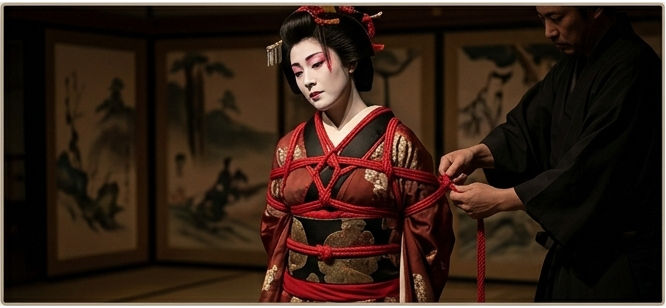
As Japan entered the peaceful Edo period (1603–1867), the practical need for battlefield restraint began to merge with theater. Kabuki theater incorporated stylized rope scenes (Seme-ba or torture scenes) to represent captured heroes.
These ties had to be visually striking to reach the back of the theater. This led to the creation of more decorative patterns that emphasized the human form.
Simultaneously, Ukiyo-e (woodblock prints) began featuring "Abuna-e" (risqué pictures). Famous artists like Hokusai and Utamaro captured the tension of the rope, planting the seeds for the eroticization of the practice.
The 20th Century: The Birth of Kinbaku-bi
The transition from martial restraint to erotic art is credited largely to Seiu Ito (1882–1961). Often called the "Father of Modern Kinbaku," Ito was an artist and historian obsessed with historical torture methods.
He began photographing his wives and models in elaborate arrangements, shifting the focus from the prisoner's plight to the beauty of the bound body (Kinbaku-bi). Ito’s work was the bridge; he took the technical "bones" of Hojojutsu and dressed them in the "flesh" of artistic expression.
The Post-War Boom
After World War II, Japan saw a surge in "SM" (Sado-Masochism) magazines. Publications like Kitan Club (founded in 1947) featured the work of legends like:
Dan Oniroku: Known as the "Godfather of SM," whose novels and films popularized the psychological intensity of the rope.
Nureki Chimuo: An artist who refined the "Nawa-shi" (rope master) persona, emphasizing the elegance and technical perfection of the lines.
The Western Expansion: How Shibari Traveled
For a long time, Japanese rope remained a "secret" art, practiced in private clubs in Tokyo. In the 1980s and 90s, the "Rope Curtain" began to lift.
The First Wave (The 80s and 90s)
The Pioneers
Westerners began studying under masters like Osada Steve and Akechi Denki. These masters were among the first to bridge the gap, teaching the technical skills of the Osada-ryu and Akechi-ryu to international students.
This led to a "fusion" style where Western BDSM safety standards (SSC/RACK) met traditional Japanese aesthetics.
The rise of the internet in the early 2000s catalyzed this growth, with the "London scene" and "San Francisco scene" becoming global hubs for modern, technical Shibari.
The Second Wave (The Internet Era)

With the rise of the internet, Shibari went viral. High-fashion photographers began using rope in mainstream media, and the "London scene" became a hub for a more modern, technical style of tying.
Today, the art is global, with thriving communities in places like Croatia, where practitioners blend traditional Japanese aesthetics with modern safety protocols.
Bedroom Bondage vs. Shibari vs. Kinbaku
To the uninitiated, "rope is rope." However, for those in the community, the terminology represents the intent of the tie.
1. Bedroom Bondage (The "Play" Level)
Focus: Sexual gratification and basic restraint.
Technique: Often uses simple knots, cuffs, or basic "figure-eight" ties.
Complexity: Low. The goal is usually to limit movement during sex rather than explore the art of the line.
2. Shibari (The "Technical" Level)
Meaning: "To tie" or "to bind."
Focus: Aesthetics and technique.
Complexity: Medium to High. Shibari is often used as a general term for the art form. It emphasizes the beauty of the rope on the body and the technical proficiency of the rigger. It is the "ballet" of the rope world.
3. Kinbaku (The "Psychological" Level)
Meaning: "Tight binding."
Focus: Emotional connection and intensity.
Complexity: High. Kinbaku often implies a deeper, more intimate, and potentially more intense session. It focuses on the power dynamic, the "Kokoro" (heart), and the psychological state of the bunny. If Shibari is the technique, Kinbaku is the feeling inside the technique.
Feature | Bedroom Bondage | Shibari | Kinbaku |
Primary Goal | Physical Restraint | Aesthetic Beauty | Emotional Connection |
Complexity | Simple | Technical/Precise | Deep/Psychological |
Material | Anything (often soft) | Jute / Hemp / Silk | Treated Jute / Hemp |
Risk Level | Low | Moderate to High | High |
The Modern State of the Art
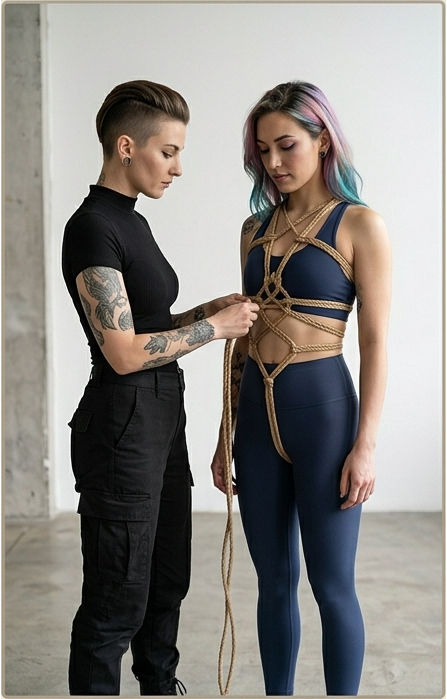
Today, Shibari is more inclusive than ever. We have moved away from the "master and prisoner" dynamic of Hojojutsu and into a space of "Active Bottoming." In the modern scene, the bunny is an equal participant whose breath and movement dictate the flow of the session.
Safety has also become the paramount concern. Modern riggers study anatomy, nerve mapping, and blood circulation to ensure that the beauty of the rope doesn't come at the cost of permanent injury. Communities like those in Croatia are focusing on workshops, "Jams" (social tying events), and peer-to-peer learning to keep the art alive and safe.
Why do we tie today?
Whether you are a rigger looking to master the perfect friction or a bunny seeking the meditative peace of the "rope high," you are part of a 600-year-old conversation. By learning the history, you transition from someone who just "knows knots" to someone who understands the weight and beauty of the line.
The rope is a bridge—between the past and the present, and between two people in the moment.
References for Further Reading
Russo, Christian (2015). Hojojutsu: The Art of Tying Your Enemy.
Master "K" (2008). The Beauty of Kinbaku.
Torigaki, Kenshin. Hojojutsu: The Samurai School of Restraint.
Ito, Seiu. History of Punishment in Japan.


Comments